Theonomy in Christian Ethics by Greg L. Bahnsen
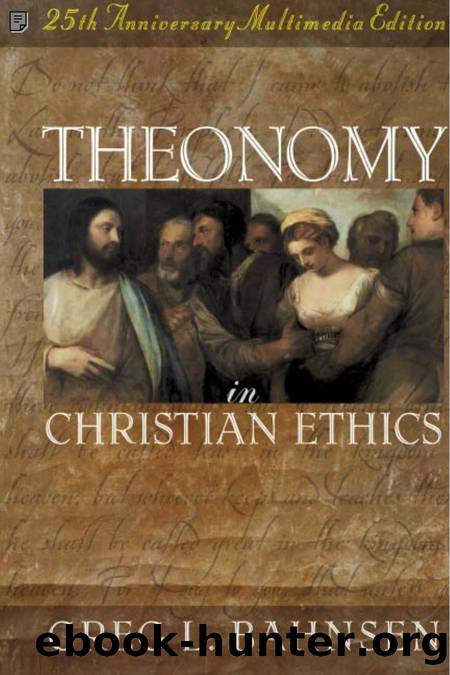
Author:Greg L. Bahnsen
Language: eng
Format: mobi
Tags: ethics, Theonomy, Law, Bahnsen
ISBN: 9780967831732
Publisher: Covenant Media Press
Published: 2002-02-26T02:12:38+00:00
Latent Antinomianism
301
Chapter 15
LATENT ANTINOMIANISM
Two Lines of Resistance
THERE are two types of antinomianism which threaten the ethic
of theonomy in the Christian Church: outright and latent. Those
who hold to the former brand see any kind of external authority which
is applied to the Christian life as repugnant to their “spiritual” free-
dom; the law of God, therefore is not the principle used for knowing
God’s will, but instead a vague notion of the Spirit “realizing” itself in the human will is the standard of moral direction. For these antinomians maintenance of the law is legalism of the letter rather than living in the Spirit; they would replace the objective authority of God’s revealed law with Christian self-determination, conscience, and “freedom” (to call
this a misnomer would be an understatement). This position is contra-
vened by all which has been written above; it represents a substitution
of autonomy for theonomy. Hence this brand of antinomianism is out
of accord with what we have found God’s word to teach about the law,
sanctification, the Spirit, the covenant, grace and love; it is simply a
non-Christian ethic baptized with Christian terminology. What has been
said previously about autonomy and its character as totally opposed to
the biblical ethic must also be applied to this mistaken idea of the
Christian life. Although many in Christian churches propound it, such
a “morality of the Spirit” is no more genuinely Christian than is “the
morality of the Serpent” which we read of in Genesis 3. Satan’s advice
is, “Look to yourself, make up your own mind; don’t lose your freedom
by legalistically following God’s command”; he urged this upon our
first parents, and he urges it upon many in the church today. The sup-
posedly “Christian” ethic of self-determination suffers the same fatal
defects as any non-Christian ethic of inclination, but an even more
302
Latent Antinomianism
serious problem is that it simply fails to square with God’s authoritative word (see previous sections of this treatise).
By not attempting to follow and do the Lord’s sayings, the antinomian
has founded his house upon the sand (Luke 6:46 ff.); although he may
honor God with the lip, his heart is far from the Lord since that which
he teaches is the precept of men. Lest we deny the Lordship of Christ
in ethics by turning the grace of God into licentiousness (cf. Jude 4)
and thereby show ourselves to be slaves of sin rather than servants of
righteousness (cf. Rom. 6:16-18), we must endorse the holy and au-
thoritative law of God in life and word and mind. “O how love I thy
law! it is my meditation all the day” (Ps. 119:97, AV); by faith that law is established in our lives (Rom. 3:31). The Spirit witnesses to the law and empowers our obedience; thereby all humanistic morality and every
competing authority is chased away. The dark night of sin must yield to
the Light.
The latent brand of antinomianism is also quite prevalent today
among Christians. Although there is an evident concern for God’s law,
this attitude still feeds upon the polluted stream of autonomy. Latent
antinomianism gladly accepts the place of God’s law in the Christian
life, and so on the surface it does not appear—and in many cases is not
intended—to be antinomian in its outlook.
Download
This site does not store any files on its server. We only index and link to content provided by other sites. Please contact the content providers to delete copyright contents if any and email us, we'll remove relevant links or contents immediately.
The Lost Art of Listening by Michael P. Nichols(7507)
Why I Am Not A Calvinist by Dr. Peter S. Ruckman(4154)
The Rosicrucians by Christopher McIntosh(3521)
Wicca: a guide for the solitary practitioner by Scott Cunningham(3180)
Signature in the Cell: DNA and the Evidence for Intelligent Design by Stephen C. Meyer(3140)
Real Sex by Lauren F. Winner(3025)
The Holy Spirit by Billy Graham(2954)
To Light a Sacred Flame by Silver RavenWolf(2826)
The End of Faith by Sam Harris(2744)
The Gnostic Gospels by Pagels Elaine(2536)
Waking Up by Sam Harris(2461)
Nine Parts of Desire by Geraldine Brooks(2373)
Jesus by Paul Johnson(2364)
Devil, The by Almond Philip C(2337)
The God delusion by Richard Dawkins(2313)
Heavens on Earth by Michael Shermer(2285)
Kundalini by Gopi Krishna(2187)
Chosen by God by R. C. Sproul(2165)
The Nature of Consciousness by Rupert Spira(2109)
